 Back
The Breeder Gallery moved to Metaxourgeio in 2008. At the time, the neighborhood was one of the cheapest in central Athens — a former industrial and red-light district that most agents wouldn't recommend. The gallery brought attention, the attention brought other galleries, the galleries brought ambitious restaurants, the restaurants brought renovators. Today, central Metaxourgeio runs at €2,000–€2,800/m² for unrenovated stock and well above for refurbished. The Breeder is still there.
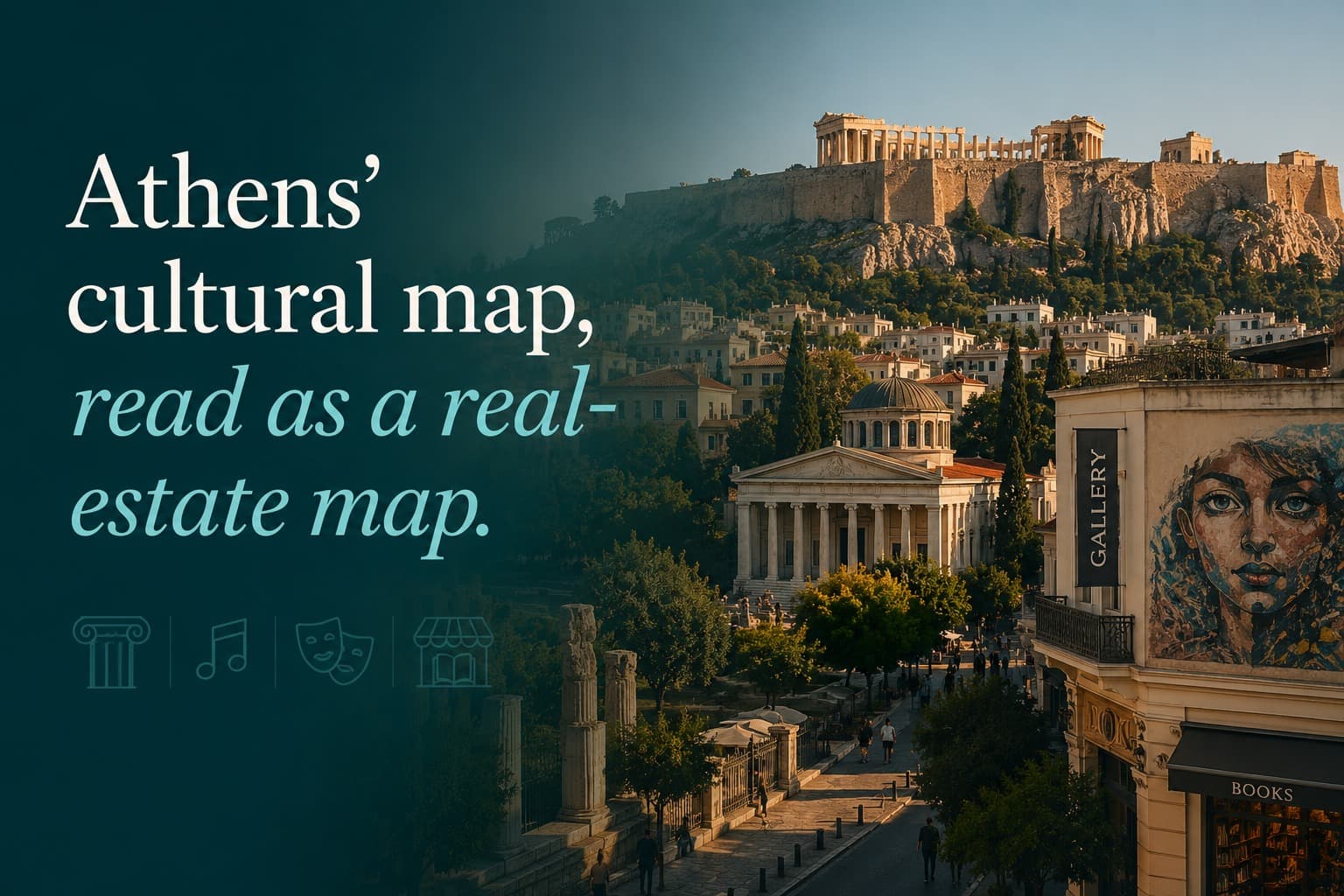
This is a pattern. Cultural infrastructure — galleries, live music venues, independent theatres, serious bookstores — precedes capital. It rarely follows it. For an investor reading the Athens market in 2026, the cultural map is not a "nice to have" — it is one of the more reliable leading indicators of which neighborhoods will reprice in the next cycle.
Why cultural geography correlates with property cycles
Three mechanisms. First: artists and cultural operators are constrained by rent, so they cluster in undervalued central districts. Second: their work draws a demographic — younger professionals, creative workers, international visitors — that values walkable, atmospheric neighborhoods over generic suburbs. Third: once a cultural identity is established, the neighborhood becomes attractive to renovation capital, then to long-term residents, then to the buyer market. The cycle from gallery opening to substantive price reset typically runs five to eight years.
The 2026 reading: where culture is signalling
| Neighborhood | Cultural anchors | Cycle stage | Current €/m² |
|---|---|---|---|
| Metaxourgeio | The Breeder, Bios, Embros (theatre) | Mid-cycle, deepening | €2,000 – €2,800 |
| Psiri | Embros, multiple small theatres, music | Active, partially priced in | €2,400 – €3,200 |
| Exarchia | Kyttaro (legendary rock), bookstores, independent venues | Re-priced post-metro 2024 | €2,200 – €3,000 |
| Thissio | Bernier/Eliades, walking distance to Acropolis | Mature | €3,200 – €4,500 |
| Pangrati | Spondi, Theatro Porta, Lexikopoleio (bookstore) | Mature, still moving | €2,800 – €3,800 |
| Petralona / Gazi south | Gazarte (rooftop venue), Half Note (jazz) | Early-mid | €2,000 – €2,800 |
| Cultural anchors selected for sustained operation (5+ years) and meaningful audience draw. Cycle stage reflects 2026 transactional data and forward indicators. | |||
Three neighborhoods worth reading carefully in 2026
Metaxourgeio — a deepening, not exhausted, cycle
Metaxourgeio is the canonical case for the cultural-anchor pattern. The Breeder still anchors the contemporary art identity. Bios has become a multi-format cultural venue (gallery, performance, bar). Embros, the self-managed theatre in Psiri but spiritually adjacent, draws audiences across the border. The food scene caught up around 2023–2025 (see our dining piece). Despite ten years of repricing, central Metaxourgeio still runs at the lower end of central Athens — and offers the deepest Zone C conversion inventory in the market.
Exarchia — repriced by metro, still anchored by culture
Exarchia is unusual: the cultural identity (independent bookstores, alternative music, political-cultural history) is decades old, but the property cycle reactivated decisively when the metro station opened in 2024. The neighborhood is no longer "early" in any sense — but it remains underpriced relative to its location (genuinely central, walking distance to Syntagma and the National Archaeological Museum), and the cultural infrastructure is durable.
Petralona & Gazi south — the early-cycle read
Gazarte's rooftop programming and Half Note's jazz nights anchor a small but growing concentration of live music in the southern part of Gazi and adjacent Petralona. The neighborhood has not yet had its repricing event, but the indicators (cultural infrastructure, metro proximity, adjacency to Thissio and Koukaki) line up. The dining signal is reinforcing the cultural signal.
How investors should actually use this
The cultural map is not a primary screen — it is a tiebreaker. The primary screens are still the structural ones we lay out in our Athens neighborhoods analysis: building stock, metro access, demand engines, planning context. The cultural reading does two things on top: it gives you a sense of whether a neighborhood is genuinely in motion or merely cheap, and it tells you something about the tenant base you would inherit if you let the property out.
For long-term rental investors
Neighborhoods with cultural depth tend to attract higher-quality long-term tenants — university faculty, public-sector cultural staff, international researchers, designers, architects. These are tenants who pay reliably, stay longer, and treat the property well. The neighborhood premium translates into a tenant-quality premium.
For short-term-let investors (where legally permitted)
Cultural infrastructure draws the leisure traveller who pays a premium for an authentic neighborhood experience over a generic city-centre apartment. Average daily rate (ADR) is meaningfully higher in Metaxourgeio, Thissio, and Plaka than in equivalent-sized units in less cultural districts. Note: Athens' central short-term-let licence moratorium applies through 2026 and affects much of this geography. Confirm STR licensing carefully before underwriting on short-term yield.
For lifestyle buyers
This is the most direct application. If a substantial portion of your life will be spent in this property, the cultural geography is the most important thing on this list. Books, music, theatre, galleries, walkable streets — these are the texture of daily life, not the texture of an investment thesis.
The cultural map of a city is also its real-estate map, with about an eighteen-month lead. The trick is recognising the cluster before it becomes obvious.
The honest cautions
- One venue is not a cluster. A single ambitious opening does not make a neighborhood. Look for at least three independent operators of meaningful scale within walking distance, sustained over 18+ months.
- Cultural anchors don't always re-rate the streets two blocks away. The repricing effect tends to be tightly geographic — within a 3–5 minute walk of the anchor. Beyond that, the structural fundamentals dominate.
- "Cultural" doesn't always mean "rental-friendly." Some cultural districts (Exarchia historically) attract a tenant base that is harder to insure or harder to evict if problems arise. The risk profile is real and worth assessing.
- Public-sector cultural infrastructure (museums, opera) is different from private. Public infrastructure raises the floor; private operators move the ceiling. Both matter, but they signal different things.
Cultural geography is not the primary thing about an Athens investment — but used as a confirmation lens on a shortlist that already passes the structural screens, it is one of the more useful filters available to you. If you want to walk a specific neighborhood through this reading, the Nexus team knows these streets and can give you a candid take on what's signal and what's noise.
Reading a specific Athens neighborhood? Let's walk it together.
The cultural signal works best when you map it onto specific streets and buildings. Tell us where you are looking, and we will tell you what we're seeing on the ground.
Walk the map