 Back
In 2023, a non-resident buyer applying for a Greek mortgage faced a frustrating combination: high rates, conservative LTVs, and bank credit committees that were not configured to evaluate foreign income. Two years and 175 basis points of ECB cuts later, the picture is meaningfully better — but the documentation reality has not changed. If you understand what banks actually look at, the process is manageable. If you don't, it can stall an otherwise clean transaction for months.
This is what mortgage financing in Greece looks like in May 2026 for an international buyer.
Where the rates sit right now
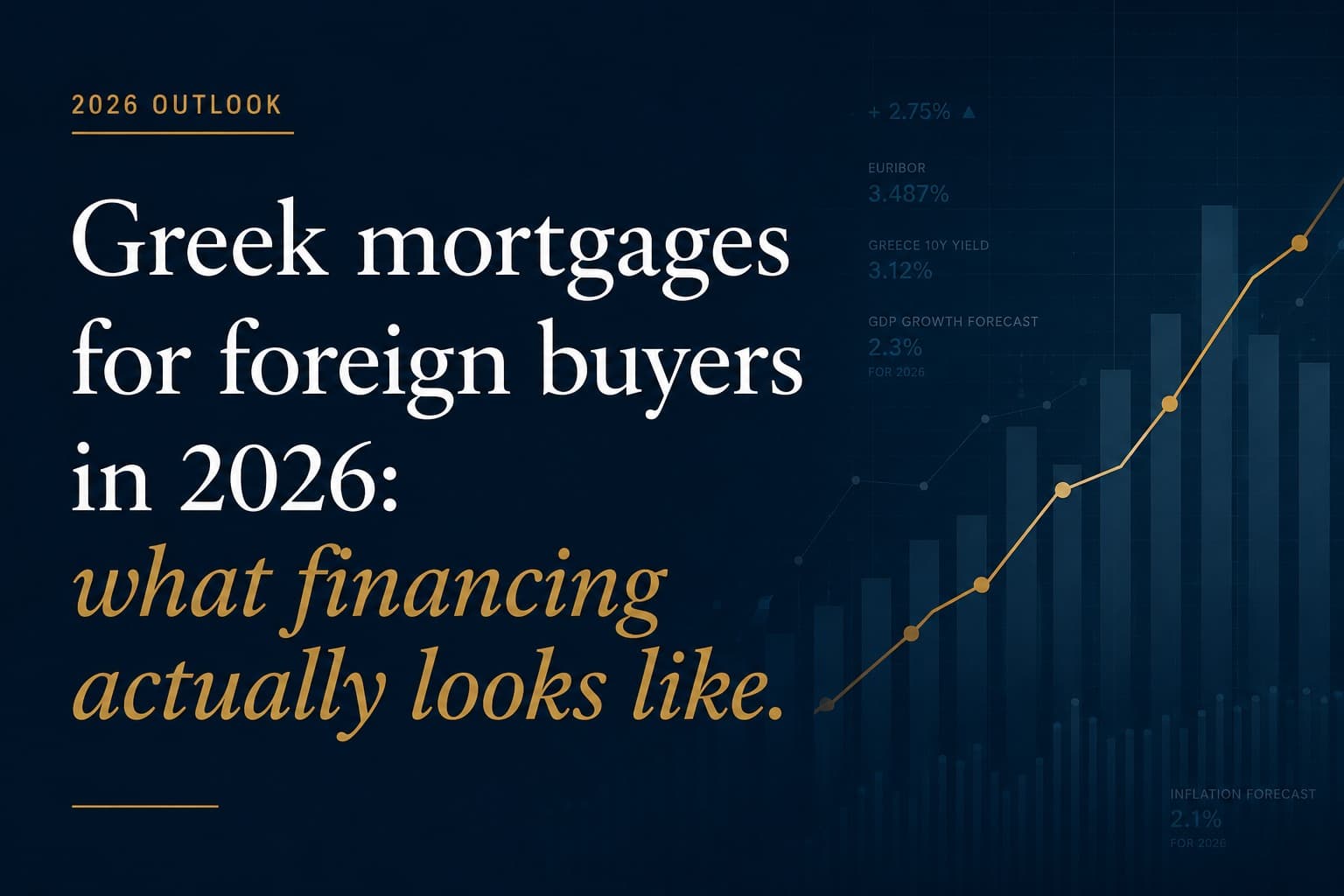
The ECB cut its main rate from 4.50% (late 2023) to 2.40% by spring 2026 through a sequence of moves tracked at ECB key rates. Greek mortgage rates have followed, though with a typical lag and a country spread. As of May 2026, the typical ranges for international buyers at major Greek banks (Alpha, Piraeus, National Bank of Greece, Eurobank) are:
LTV: what you can actually borrow
Greek banks differentiate sharply between three borrower categories. Knowing which one applies to you is the most important single thing in this process.
If you intend to use the property for a Golden Visa application, you must own a level of equity that meets the relevant zone threshold (€250K / €400K / €800K). A mortgage can sit alongside that equity — the visa rule concerns the purchase price and your equity contribution, not the financing structure. Discuss the exact structure with your Nexus advisor and lawyer before signing the preliminary contract.
The realistic timeline
Optional but strongly recommended. Pre-approval (proschediasmos) gives you a documented borrowing capacity and turns you into a credible buyer at the negotiation stage. Costs nothing and saves weeks later.
Last 2 years of tax returns, last 6 months of bank statements, employer letter (or company financials for self-employed), proof of source of funds for the down payment, AFM (Greek tax number), and a Greek bank account. Non-EU buyers may be asked for additional anti-money-laundering documentation.
Once the property is selected, the bank arranges its own valuation. The bank lends against the lower of agreed price and valuation — so an unrealistic asking price will be quietly capped.
Credit committee approval, fixed offer letter, and loan agreement drafted in Greek and translated. Your lawyer reviews both. Standard product; little to negotiate beyond the rate.
The mortgage is registered against the property at the same notary appointment as the transfer deed. Funds are released by the bank directly to the seller's account on the day of signing.
End-to-end, a well-documented non-resident mortgage typically takes 8–12 weeks from first application to drawdown. Cleanly-prepared files run faster; thinly-documented files stall.
The all-in cost: what financing actually adds
| Cost | Rate / amount | On a €500K / €325K loan |
|---|---|---|
| Loan origination / arrangement fee | 0.5 – 1% | €1,625 – €3,250 |
| Bank valuation | €250 – €600 | ~€400 |
| Mortgage registration at Cadastre | 0.775% | ~€2,520 |
| Building & life insurance (annual) | 0.1 – 0.2% | €500 – €1,000 / year |
| Lawyer additional review | ~€500 – €1,000 | One-off |
| These costs are on top of the standard ~7–10% buyer's costs detailed in our buying guide. | ||
Five practical tips that actually save money
- Get pre-approval before you fall in love with a property. Without it, you negotiate from a weaker position and lose time on properties you can't fund.
- Document the source of funds early. Anti-money-laundering requirements are strictly enforced. A clean paper trail for the down payment — sale of an asset, inheritance, savings history — accelerates everything that follows.
- Compare fixed vs Euribor-linked carefully. In a falling rate environment (2024–2025), variable was the winner. In 2026, with the cycle near bottom, a 5-year fixed at 4.4% looks attractive against likely future rate paths.
- Negotiate the margin, not the base. Euribor is set by the market. The bank's margin (1.8–2.4% in 2026) is negotiable, especially on larger loans and with a relationship.
- Don't take the first bank that says yes. The four major Greek banks price differently for international borrowers, and the variance can be 30–60 basis points on the same profile. Your Nexus advisor can run you in parallel.
In a rate cycle that has stabilised, the difference between a well-structured mortgage and a default one is not the headline rate. It's the timeline, the LTV, and which bank you chose.
If you are considering financing rather than paying cash, the structure is worth getting right from week one — it shapes what you can offer on the property, how quickly you can close, and what your cash position looks like after completion. The Nexus team works with all the major Greek banks and can map your specific profile to the lender most likely to give you the best terms.
Financing a Greek purchase? Let's pick the right bank from day one.
EU vs non-EU, resident vs non-resident, fixed vs variable — the structure that fits depends on your specific profile. A short conversation maps the right path before you commit.
Talk financing strategy