 Back
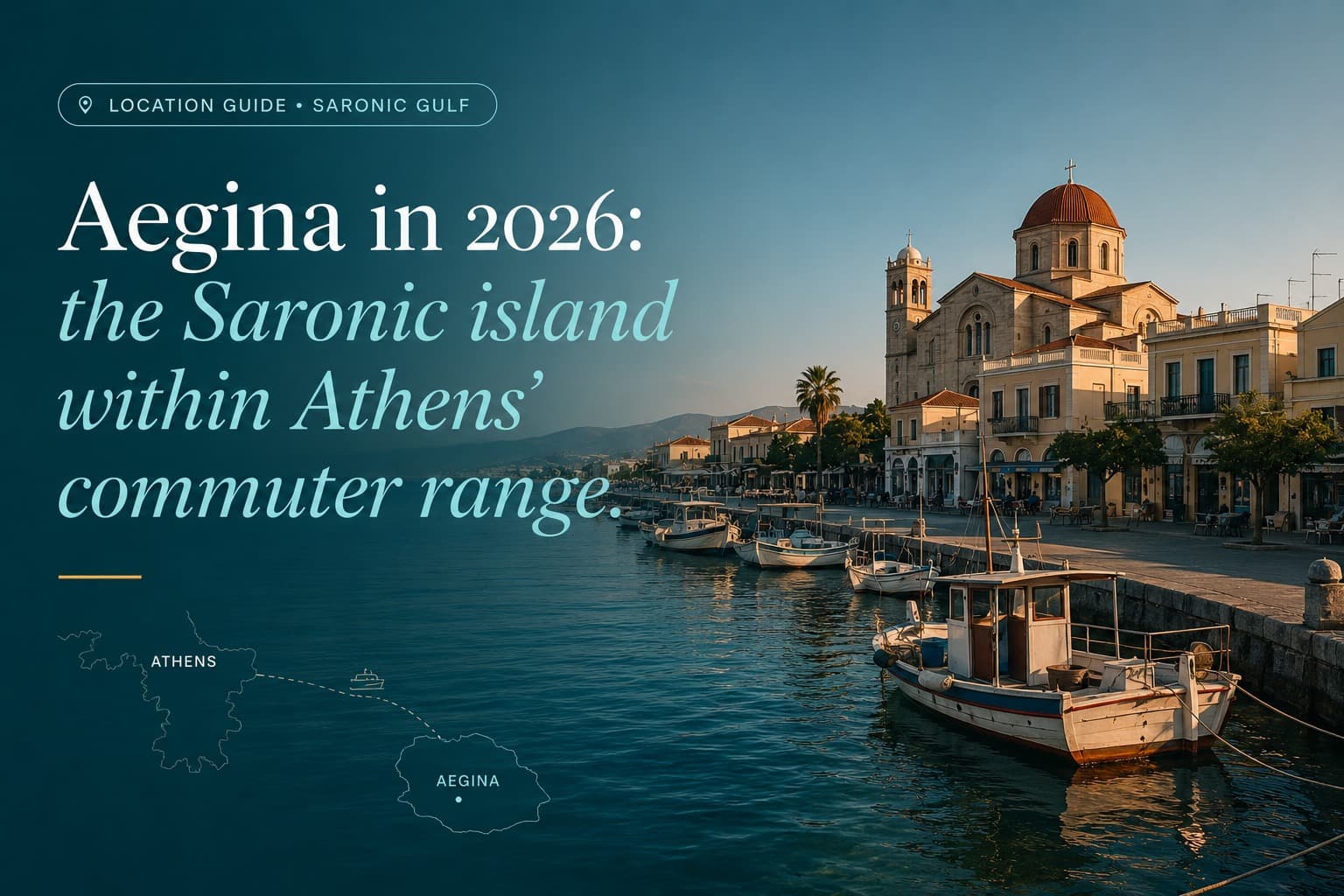
Take the 8.40 high-speed from Piraeus on a weekday morning in May and you arrive in Aegina town at quarter past nine. The harbour is still half-asleep. The pistachio vendor on the quay is opening his stall. There are sailing boats in the marina and a working fishing fleet at the end of the breakwater, and the headland behind town is dotted with stone houses and citrus orchards that look — and largely are — unchanged in a hundred years. By eleven, on a clear day, you can be back in Athens for lunch.
That proximity is what makes Aegina unusual. It is the closest island to Athens, the only one within practical commuter range, and one of the few Greek islands with a real year-round resident economy that doesn't depend on summer tourism. The investment story here is not a beach play. It is a Saronic-Gulf-meets-Athens story, and it has been quietly compounding for a decade.
Older guides — including some that still circulate — say Aegina qualifies for the €250,000 Golden Visa threshold. This has not been true since the August 2024 reforms. Aegina's resident population is approximately 13,000, well above the 3,100 cut-off, which places it firmly in Zone A at €800,000 minimum for residential property. The €250,000 Zone C conversion pathway is available on Aegina the same way it is everywhere else in Greece — but standard residential purchases require the €800K threshold. Verify with your advisor before structuring any application.
What Aegina actually is in 2026
Aegina is a 90-square-kilometre island in the Saronic Gulf, 27 kilometres south-southwest of Piraeus. It has a population of around 13,000 — substantial for a Greek island and unusual in being a working community rather than a tourist economy with a seasonal staff. The pistachio cultivation that gives the island its identity is a real industry: Aegina pistachios are PDO-protected and continue to anchor the local economy. The Temple of Aphaia and the historic capital function (Aegina was briefly the capital of independent Greece in 1827–1829) give the island a cultural depth that most Saronic destinations lack.
The infrastructure is unusually good for an island of this size. Two ferry routes operate Piraeus–Aegina year-round: the conventional ferry (about 75 minutes) and the high-speed catamaran (about 40 minutes). Crossings run from before 7am to past 9pm in season, and at reduced frequency year-round. There is a hospital, multiple schools, a full supermarket cohort, and reliable utilities.
The micro-markets: where to actually buy
| Area | Avg €/m² | Character |
|---|---|---|
| Aegina town & harbour | €2,400 – €3,400 | Walkable centre, neoclassical and traditional stock, year-round amenities. Best for commuters and lifestyle buyers who want infrastructure. |
| Perdika | €2,000 – €3,000 | Small fishing village on the south coast. Excellent tavernas, working harbour. Strong appeal to international second-home buyers. |
| Agia Marina | €2,200 – €3,000 | East coast beach resort. Higher seasonal density, strong short-let market in summer. |
| Souvala & north coast | €1,800 – €2,500 | Quieter, residential. More accessible entry point. Mixed Greek and international buyer base. |
| Interior villages (Mesagros, Anitsaio) | €1,200 – €2,000 | Pistachio orchards, stone houses, traditional. Renovation potential. Limited liquidity. |
| Sources: Nexus market data and indomio.gr listings, Q1 2026. | ||
Who buys here and why
The Aegina buyer profile is distinctive. There are three main cohorts:
- Athenian second-home owners. The largest group. Athenians (and Greeks based abroad with Athens roots) have bought weekend and summer homes on Aegina for generations. This is a deep, stable, year-round buyer base that supports prices in normal years.
- International commuters and remote workers. Growing cohort. People with work commitments in Athens — a few days a week in the office, the rest remote — for whom the 40-minute ferry is a genuine alternative to a suburban commute. Aegina town and Perdika are the strongest fit.
- European lifestyle buyers. Predominantly German, French, Dutch, British. Drawn by the proximity to Athens combined with island character, the pistachio-economy authenticity, and prices that compare favourably to Cycladic alternatives.
What you will not find in volume here: mass-tourism short-let demand of the kind that drives Mykonos or Santorini yields. Aegina's tourism is real but modest — heavily weekend-driven from Athens, plus a Northern European summer cohort. Yield expectations should be calibrated to this reality.
Realistic yields and seasonality
The Aegina rental season is roughly May–September with weekend traffic year-round from Athens. The premium properties in Perdika and Agia Marina that combine direct sea access with capacity for a family or small group achieve the higher end of this range; standard apartments without those features achieve the lower end. Long-term rental in Aegina town has become a viable alternative thesis, driven by the commuter cohort, with the advantage of lower management overhead.
The honest cautions
- Liquidity is moderate. Aegina is not Athens. Listed inventory is meaningful but selling timelines can be longer; six to twelve months on the market for an unfurnished property is normal. Plan a longer holding period than you would in central Athens.
- Title diligence on older village properties. Pistachio-orchard houses are often inherited across generations with incomplete title documentation. Hellenic Cadastre coverage is good but not universal on Aegina. Allow extra time for due diligence on interior properties.
- Water supply. Aegina relies partly on water transported by tanker from the mainland in summer. Properties with reliable water access — town, established villages — are materially more comfortable. Remote properties may require tanker-fill cisterns.
- The €250K Golden Visa misconception. Confirm Zone A pricing applies before designing any purchase around the Golden Visa. The €250K route on Aegina exists only via commercial-to-residential conversion, and qualifying conversion stock is limited.
Aegina works for buyers who value real-place texture over island glamour, and who can accept moderate liquidity in exchange for the rarest thing on the Greek island map: genuine Athens proximity.
Aegina is not a flip market and it is not a high-yield short-let market. It is a long-hold lifestyle and capital-preservation asset with respectable rental performance and a structural proximity advantage that no other Greek island matches. For the right buyer — Athenian-connected, lifestyle-led, comfortable with the longer holding period — it is one of the more interesting things on the Greek property map.
Aegina property listings Golden Visa 2026 guide Buying process guide
Considering Aegina? Let's structure it correctly.
Golden Visa zoning, water and title diligence, and matching the right sub-market to your use case all matter on this island. A short conversation usually clarifies the right path.
Talk Aegina strategy