 Back
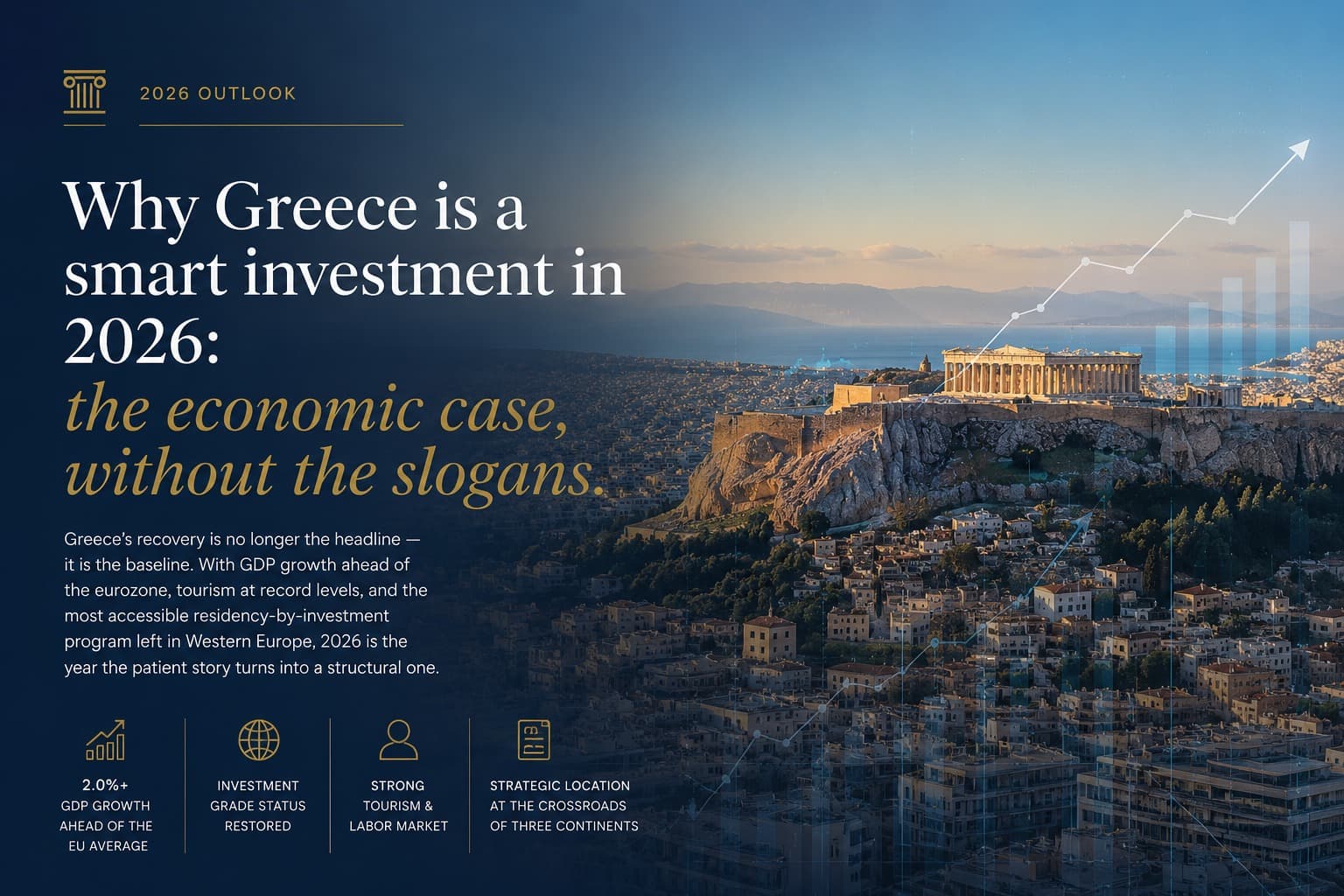
In 2023, Greece quietly did something that would have seemed implausible a decade earlier. The country regained investment-grade credit ratings from S&P, Fitch, and DBRS — and by late 2025, from Moody's as well. That technical milestone matters more than it sounds: it triggered passive flows from institutional investors who are mandated to hold only investment-grade sovereign debt. The capital that had skipped Greece for fifteen years started showing up again.
That is the macro backdrop for what is happening in Greek real estate in 2026. The investment case is not a feeling about beaches and feta. It is a set of measurable things: interest rates trending down, foreign direct investment trending up, a Golden Visa absorbing demand from closed Iberian programs, and a residential market with a genuine, durable supply problem in the cities that matter.
The macro: growth without the noise
Greece's GDP is projected to expand by 2.3% in 2026 according to the IMF, comfortably above the eurozone average. Unemployment, which peaked above 27% in the worst years of the crisis, is now running around 9% and continues to trend down. Inflation has normalised to roughly 2.5% and the ECB rate-cutting cycle of 2024–2025 has fed through into mortgage rates that — for the first time in over a decade — are comparable to those across the eurozone.
The ratings upgrades unlocked a second-order effect that gets less coverage: a meaningful re-rating of Greek corporate and bank debt, which in turn lowered the cost of capital across the economy. Construction, in particular, is benefiting. Building permits for residential projects are running at multi-year highs, and the supply pipeline in Athens and Thessaloniki is finally responding to demand — though, as we discuss below, not fast enough to ease prices.
The real estate fundamentals: where the demand actually comes from
Greek residential prices have appreciated steadily for five consecutive years, with the strongest moves in Athens (driven by both domestic and foreign demand), Crete (international lifestyle), and the Athens Riviera (the Ellinikon effect — see our Athens Riviera analysis). What is structurally different about 2026 is the diversity of the demand:
This buyer diversity is the structural advantage. The Greek market is no longer dependent on any single national source of demand — which is why the closures of the Spanish and Portuguese real estate visa routes have benefited Athens disproportionately. Knight Frank's 2026 wealth report tracks Athens as one of the top European cities for net inbound HNW relocation, a category dominated for years by Lisbon and Madrid.
What is genuinely different in 2026
The Golden Visa is the most accessible left in Western Europe
Portugal closed the real estate route. Spain shuttered its program entirely in April 2025. Ireland ended its IIP. Malta restructured. Greece's three-zone Golden Visa — €250K conversion, €400K regional, €800K premium — is now the most flexible major program in Western Europe, and the only one tied to physical real estate at this price range. We treat the rules and Law 5275/2026 amendments in detail in our Golden Visa 2026 guide.
VAT on new construction is suspended through end-2026
Under Law 5246/2025, the standard 24% VAT on new-build residential property is suspended through 31 December 2026. For buyers of qualifying new construction, this is a one-off saving worth six figures on a typical Athens or Riviera purchase. After 2026, the standard rate is scheduled to return.
Tax structure favours new residents who actually move
The Greek non-domicile regime introduced in 2020 allows new tax residents to elect a flat €100,000 annual lump sum on global income. A separate 7% flat rate applies to foreign pension income for new retiree residents. Greece does not currently tax capital gains on personal property disposal at the individual level. None of this matters if you do not become a tax resident — but for those who do, the regime is competitive with anywhere in the EU.
Greek real estate is not a low-volatility asset. The market is cyclical, the local banking system is still digesting non-performing legacy loans, and short-term rental policy in Athens specifically is tightening (a moratorium on new STR licences in central districts is in effect through 2026). Buy for a 7–10 year horizon, not a flip in 18 months.
Where the structural growth is concentrated
| Market | What is driving it in 2026 | Reasonable horizon |
|---|---|---|
| Athens central | Urban renewal, undersupply of energy-efficient stock, year-round rental demand, metro extensions | 7–10 yrs |
| Athens Riviera | Ellinikon delivery phases through 2030, Four Seasons / Marriott / Waldorf brand effects | 10+ yrs |
| Thessaloniki | Metro now operational since 2024, port and university hub, broadly under-priced vs Athens | 5–10 yrs |
| Crete (Chania & Heraklion) | Direct flight expansion, Zone A Golden Visa upgrade, lifestyle migration | 7–10 yrs |
| Halkidiki | Zone B €400K threshold, regional resort investment, diverse buyer base | 5–8 yrs |
The Greek story in 2026 is no longer "recovery." It is "the recovery worked, and what comes next is regular European growth." For an investor that is the more interesting story — because regular growth compounds.
What this means for an investor right now
Three practical takeaways.
One. If you are buying for residency, do it before end-2026 if you have a credible new-build option in your range — the VAT suspension is real money. If you are looking at resale stock, the urgency is lower and the negotiation room is usually higher.
Two. Match the asset to the objective. Golden Visa property and rental-income property are different assets under the 2024–2026 rules. Conflating them is the most expensive mistake we see. Our buying-process guide covers the mechanics.
Three. Don't ignore Thessaloniki and the regional markets. The macro story is national; the price arbitrage is regional. The most interesting risk-adjusted returns we are watching in 2026 are not in central Athens — they are in Thessaloniki's eastern districts and in coastal Halkidiki, where Zone B pricing still applies.
Greece in 2026 is a normal European market with above-average growth, an unusually flexible residency program, and a one-year tax window that will not repeat. That combination is rare enough to be worth understanding in detail.
Looking at Greece in 2026? Let's discuss what the data means for you.
Macro tailwinds are real, but the best entry point depends on your timeline, residency goal, and yield expectations. A short conversation usually saves a season of guessing.
Book a consultation